

Frequently Asked Questions
What do you write about?
Right now I’m writing in the genre of women’s fiction. My stories and characters are often based on real-life experiences, but not a factual representation of those complete experiences. Women's fiction often focuses on motherhood, emotionally complex relationships, and strong emotional content such as trauma, domestic violence, and poverty.
Do you write under a pseudonym?
I’ve thought about it, but it’s a complicated process. I’d do it for the sake of ghostwriting, but for a majority of my content, I just want to be authentic and own my stories, including the ugly parts. These stories make me who I am, and I’m okay with sharing that.
Are there content warnings for any of your books?
Women’s fiction is known for shining a light on emotionally sensitive content. I haven’t published it yet, But I’m going to say yes. In the novel I’m currently working on “Kisses To The Moon” There are trigger warnings for domestic violence, mental illness, sexual assault, homicide, and death by cancer. I can’t see myself writing books without strong emotional content.
What age group and gender are your books intended for?
Women’s fiction generally targets people aged 18-44. Don’t let the label be off-putting though. I wouldn’t suggest gender. What I’ll say is that the content is great for people who care about the topics covered in women’s fiction. If you like emotionally led stories about motherhood, complex relationships, and the like. Then it’s for you. A lot of my characters are under the LGBTQIA+ umbrella. I hate that the genre I write is called Women’s Fiction. I think New Adult would be a better label.
What’s the biggest challenge you’ve faced as an author?
Imposter syndrome! I’ve been writing for years, and I still catch myself saying “When I’m a real writer” I made up these fake rules in my head about what distinguishes an author from a writer, and a professional from a hobbyist. A lot of people have said to me “Fake it until you make it” But when you have big dreams, It can be hard to imagine yourself in those shoes.
When did you discover you wanted to write?
This is tough. I first fell in love with writing in the seventh grade. My Teacher Mrs. Campbell-Beer made us write in a journal every day. Those journal entries were the first time I realized I had an outlet for whatever I was going through or thinking about. In high school I took my first creative writing class, I was also in theater. I learned then that I was a good storyteller. In my 20’s I went through a series of unfortunate events, and I knew I had a story inside of myself that I wanted to tell, but it wasn’t until my junior year of college that I started to take writing seriously. I think a writer is just something you are, or are not. It’s very clear now that I’ve always been a writer, I just wasn’t shining the light on it.
Are you going to self-publish or publish traditionally?
My goal is to publish traditionally. Traditional publishers have a wealth of knowledge and experience that I don’t have. I like that it makes the process smoother from beginning to end. I’m not against self-publishing, I think it can be great. It’s just a lot more work and calls for a lot of experience that I don’t have yet. There’s a big misconception that self-publishing is easier, but people don’t consider all of the roles they’ll have to take on if they want the book to sell.
When will your first novel be done?
I’m starting graduate school in the summer of 2025. I don’t know how time-consuming that will be until I’m there. Ideally, I’d like to say I’ll send it off to publishers in 2025, but I know that process has its own timeline, and I don’t yet have a signed contract. So I don’t know how to answer this question. But, my goal is to have the first draft done by the end of 2025.
How long does it take you to write a book?
I still haven’t finished my first book. I’ve had ideas in my head for years, but I didn’t start taking writing seriously until 2023. So I’m not sure. I hope future books don’t take as long as my debut is, because it feels like forever.
Do you write every day?
I should! However, I do not. My primary focus right now is getting through my education. I do take notes and build on characters and story ideas at least a few times a week. I’m always brainstorming ideas.
What life experience impacted you so much that you wanted to share your story?
I write fiction, which is sometimes based on real experiences. But I wouldn’t say that my goal is to share my exact story, I’m not writing a memoir right now. I had a rough time in high school, I was bullied to the point of having suicidal ideations, I got pregnant at eighteen by an older man, and then In my 20’s I lost both of my parents and became homeless. After overcoming homelessness, I ended up in more than one abusive relationship. My experiences with teen pregnancy, sexual assault, poverty, homelessness, and domestic violence have heavily shaped me as a writer, and the content that I write about. But please keep in mind my stories are fiction. I do not tell what really happened to me, or anyone I know. I only use my trauma as inspiration. Any likeness to characters or situations is purely coincidental.
What is your biggest challenge when writing?
The biggest challenge is actually writing. Ideas are only ideas until they’re on paper. Finding the time to sit down, and write, especially a full novel does not come easy. I always have school, or work, or family things. I need another pandemic where I can just sit down and write for four months straight. (Kidding about the pandemic part)
What advice would you give to others who want to write but don’t know where to start?
Start writing! Make up stories about people you see when you’re running errands, write a daily journal, write anything. After the habit is there it becomes natural. Everything is a story to me now. I literally think in stories, my mind is never quiet. And read! Many writers agree that you can’t be a good writer unless you read. Read a lot, read everything, read new genres, and new authors. It’s the only way to figure out what kind of writer you are.
How do you tackle short and long-term goals?
More often than not, I wing it. I wish I was kidding. I find a lot of stress in making long-term goals. My past experiences and trauma have taught me that we never know what the future holds, so I don’t spend a lot of time there. I’ll say something like “I want to get my master’s degree” And then I just follow my short-term goals until I get there. Once I’m there I set a new long-term goal. But I’ve never laid out a 10-year plan, or my whole life. So much can happen between now and then! Short-term goals are much more achievable for me. I think about what things I can do now in this moment, with the life I have and the state I’m in. and I aim for small things that are achievable and then I set a strict schedule and stick to it.
What methods do you use for executive functioning?
It's all about time management. I have a very strict schedule I follow day to day, and I rarely if ever sway from it. I know that every Sunday I clean my apartment, And every Monday I sit down to study. I know that every night at 8 pm I’m shutting off my devices and reading. I was diagnosed with ADHD a couple of years back, and I’m not being treated for it. That schedule has been imperative to my focus and overall well-being. I also take breaks when necessary. If I’m sitting at the desk staring at a blank page for three hours I know that’s not productive. It’s time to go for a walk, or dance it off in my living room, or get some water and a snack. One thing I’ve learned is that the creative process can’t be forced.
What do you know now about writing that you didn’t know when you started?
It's a lot more than just putting words on paper. There’s a whole industry dedicated to writing and publishing. This isn’t the type of work someone wants to reinvent the wheel with. It’s all been done before. The only way to be good at it, is to study it and work for it. This means a lot of reading, a lot of workshopping, and a lot of trial and error. I used to think I could write something great and I’d magically get noticed and recruited to write a NYT bestseller. That’s just not how any of it works.
Who do you want to inspire with your writing? And who do you hope will read it?
I hope everyone reads it, I would love to know that people from all walks of life are picking up and reading my novels. But I guess who I hope to inspire the most are the young women who have already experienced a lifetime of trials and tribulations. The young adults without families, the young women with no place to call home. Those who feel isolated, alone, and neglected by society. I hope to be living proof to them that there’s always a way out. And that if they give up, they can’t glow up.
Do you write just by typing, or do you also write traditionally with a pen?
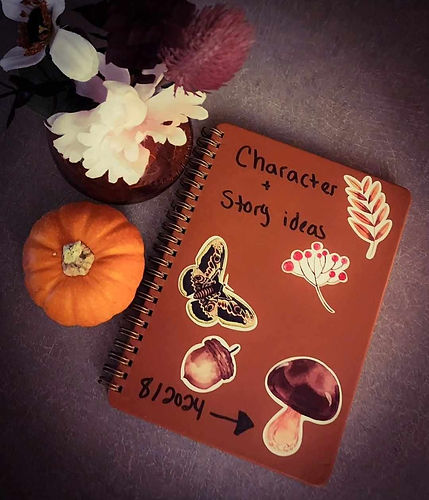
I do both. The bulk of my writing is typing, but oftentimes if I’m writing character sketches, or ideas, or poetry I write it down on paper first. I have piles of notebooks full of notes, It’s only when I decide they’re actually useful that I type them up. When I was studying photography I learned that it’s best to have your files saved in three places, I do something similar with writing. I can’t imagine losing it all because it was only saved in one place.
Do you have a question I didn't answer? Ask me below.
Get in Touch
Feel free to reach out to me via email or phone to discuss collaborations, writing opportunities, or simply to share your thoughts on my work.
